
Dating Culture in France: What Expats Should Know
Dating culture in France is often described through its vocabulary, and that is a useful place to start: some people say there is no exact equivalent of the English sense of "dating" as a distinct phase with its own rules. People see each other, repeatedly, and at some point they are together — sometimes without an explicit conversation marking the change. That is a tendency some describe rather than a rule, and expectations vary widely by city, age and individual. France also holds very different social worlds, from large international cities to small rural communes. Use this as context for better questions, and see explore more country dating guides for how it sits alongside other destinations.
How People Meet in France
- Through friends. Introductions within an existing circle are common, and group settings often come before anything one-to-one.
- Through activities. Sports clubs, classes, hiking groups, music and amateur associations.
- Through work or study. Particularly in university cities and among internationals.
- Through international communities. Language exchanges, expat associations and coworking spaces, most visible in the larger cities.
- On dating platforms. Widely used, and often the first route after a move.
- Through neighbourhood life. The same café, the same market, the same street over time.
We would not claim a single route dominates nationally without data to support it.
Social Life and Dating
Meals do a lot of the social work. A long dinner or a drawn-out lunch is a normal setting for getting to know someone, and the duration is the point rather than an accident. An evening that runs to three hours has not necessarily gone better than one that runs to one; it may simply be the format.
Groups matter too. Being invited to something with friends rather than alone is common and is usually inclusion rather than hesitancy.
Who pays varies by person and situation. Splitting is ordinary, one person paying is ordinary, and neither carries a fixed meaning. Agree lightly rather than assume.
Timing and Planning a Date
Dinner often starts later than in northern Europe, and eight or half past is unremarkable. Restaurant kitchens frequently close between lunch and dinner service, so a mid-afternoon meal can be harder to arrange than you expect.
Many smaller shops and some businesses close on Sundays or for part of Monday, which shapes what a weekend plan can be. In August, a good number of businesses in smaller towns close for several weeks.
Confirm the time and the exact place. On punctuality, we would avoid the stereotype: how precisely someone keeps to a time is personal, and labelling a country is the shortcut this guide tries not to take.
Communication and Language
French has a formality distinction English lacks: vous for formal address and tu for informal. Among younger people in social settings tu is often used quickly, but the distinction is real and the shift can carry meaning. Following the other person's lead is the simple approach.
Do not assume someone would rather speak English. Many people will, particularly in the larger cities and among younger people, but switching without asking can land as a presumption. Making an obvious effort with French is generally well received; presenting it as a project you expect the other person to run is not.
Be honest about your level rather than overstating it, and ask when you have not understood instead of nodding. Irony and wordplay are common and travel badly in a second language in both directions, so check rather than assume a remark meant what it sounded like. Correcting someone's English unprompted rarely goes down well.
Affection, Personal Space and Consent
La bise — a light kiss on each cheek as a greeting — is a widespread convention, and the number varies by region and by circle, from one to four. It is a greeting, not a signal, and plenty of situations call for a handshake or nothing at all instead.
How much physical affection someone is comfortable with, in public or at all, is personal rather than national. Ask and respect the answer. Consent is not a cultural variable, and no local convention obliges anyone to accept contact they do not want. If you are unsure how to greet someone, following their lead or simply asking is always acceptable.
Dating Local People and Other Expats
Dating local people in France
A French partner changes daily life in ways time alone does not: how friendship groups work, what holidays actually involve, the version of the language people use with friends, the places no guide lists. What to avoid is treating someone as a shortcut into the culture or as language practice.
Dating other expats in France
You start from shared ground — the titre de séjour, the bank, the paperwork that needs a document nobody has heard of. Often a shared working language too. The conversation worth having early is about time, because contracts end and plans change.
Neither is better and many people do not choose. You can meet expats and international singles in France through our destination guide, with a city page for Paris.
First-Date Ideas in France
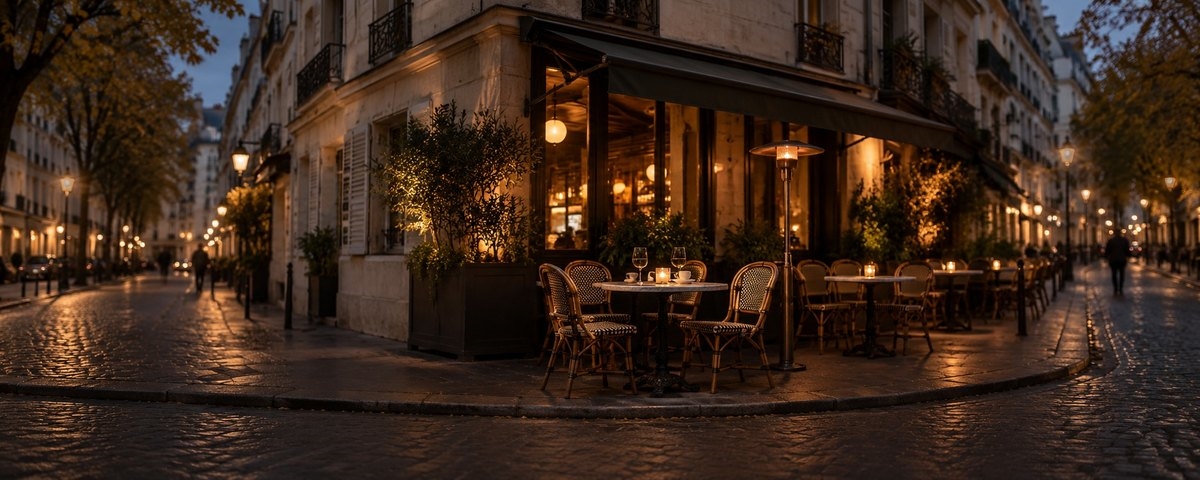
- A drink on a café terrace. The default for good reason: public, open-ended and easy to leave.
- A walk through an old quarter or along a river. Costs nothing and is easier than sitting opposite a stranger.
- A museum or exhibition. Useful across a language gap, and there is something in front of you to talk about.
- A market during opening hours. Bright, busy and full of small shared decisions.
- A seafront or canal walk in coastal and riverside cities.
- A cultural event. Low pressure, with other people in the room.
Arrange your own way there and back, and pick somewhere central enough that either of you can leave early without it being a statement.
Talking About Relationship Expectations
If exclusivity is sometimes assumed rather than negotiated, the practical consequence is that you should not wait for a conversation that may never be offered. Asking where you both stand is reasonable and is unlikely to be taken badly; assuming is the riskier option in either direction.
Two subjects matter more when one of you has moved: how long you expect to stay, and which language a relationship would settle into. Both cost less raised in the first weeks than in the sixth month. Our guide to dating as an expat covers that in more detail.
Meeting friends or family does not carry one fixed meaning. For some people it is a significant step; for others the group was always going to be there. Ask rather than decide.
Staying Safe on a First Date in France
- Meet somewhere public and central, and easy to find.
- Arrange your own transport both ways.
- Tell a friend where you are going and when you expect to be back.
- Keep your phone charged and enough money to leave at any point.
- Do not share your home address before meeting.
- Never send money, whatever the reason given.
- Use the block and report tools on anything that feels wrong.
Our dating safety advice covers the warning signs in detail.
France Is Not One Single Dating Culture
Experiences differ widely. Paris is unlike the rest of the country in scale, pace and international mix. Large regional cities have their own established social worlds. University cities skew younger and turn over each academic year. Coastal areas include long-settled foreign communities whose social life looks quite different. Rural areas are smaller and more settled, with everything that implies in both directions. Regional languages and identities matter to some people and not to others.
We are deliberately not characterising regions by temperament. Where you are matters because of who lives there and how life is organised, not because of a regional personality.
Frequently Asked Questions
What is dating culture like in France?
Meals and groups do a lot of the social work, evenings start later than in northern Europe, and some people describe relationships as becoming exclusive without an explicit conversation. Beyond that it varies by city, age and individual far more than by nationality.
Do I need to speak French to date in France?
In the larger cities, often not, particularly among younger people and international communities. Outside them it matters more. Do not assume English is preferred — asking which language someone would rather use is a small courtesy that is noticed.
What is the difference between tu and vous on a date?
They are the informal and formal forms of address. Among younger people in social settings tu is often used quickly, but the distinction is real and moving between them can carry meaning. Following the other person's lead is the simplest approach.
Is la bise a sign of interest?
No. It is a greeting convention, and the number of kisses varies by region and circle. Plenty of situations call for a handshake or nothing instead. It says nothing about romantic interest.
How can I meet expats and local people in France?
Repeated activities work best: clubs, classes, language exchanges, volunteering. International associations help in the first weeks, and keeping one locally organised commitment stops a social life becoming entirely international. See how to meet people in a new country.
What should I avoid assuming?
That a long meal means the evening went better, that la bise is a signal, that English is preferred, that exclusivity will be announced, and that Paris describes the country.
Related Reading
Explore Expat Dating in France
Who is actually here, which cities have the larger international communities, and what a first meeting tends to look like locally.